Hydro Jetting vs. Drain Snaking: Which One Does Your Clog Actually Need?
Two ways to clear a clog. One blasts your pipes clean with high-pressure water. The other punches a hole through the blockage. Knowing which one your drain needs can be the difference between a one-time fix and calling a plumber every six months.
Talk to a Plumber TodayHydro Jetting vs. Snaking — The Short Version
Hydro jetting is better for recurring clogs, grease buildup, tree roots, and full-pipe cleaning — it uses 1,500 to 4,000 PSI water to scour the entire inside of your pipes. Drain snaking is faster and more affordable for simple, single-fixture clogs like hair, soap, or a paper jam — it uses a flexible auger cable to punch through or pull out a single blockage. If your drains clog more than twice a year, hydro jetting is almost always the smarter long-term fix.
Why This Choice Matters More Than You Think
Most Massachusetts homeowners don't think about how a clog gets cleared — they just want the water moving again. But the method matters. Pick the wrong one and you'll be back on the phone with a plumber in three months. Pick the right one and you might not need another drain service call for years.
The pros at A1 Discount Plumber have cleared thousands of drains across Eastern MA — old cast iron sewer lines, modern PVC, kitchen lines packed with decades of grease, and main lines wrapped in tree roots. Here's what we tell every homeowner who asks "should you snake it or jet it?"
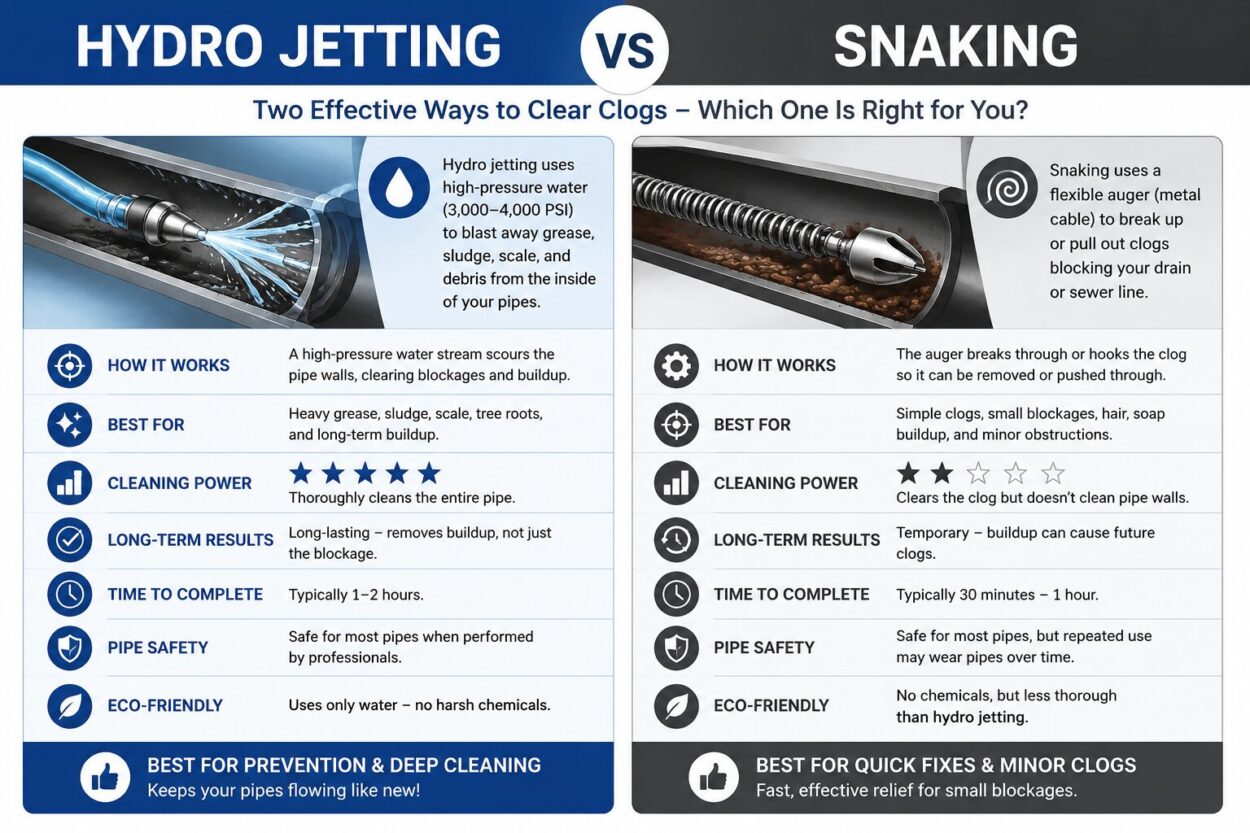
Hydro Jetting vs. Snaking at a Glance
The side-by-side breakdown most homeowners ask for — how each method works, what it's best for, cleaning power, lifespan of the fix, and more.
How Each Method Actually Works
Both clear clogs. They go about it in completely different ways — and that difference is exactly why one of them might be wrong for your pipes.
High-Pressure Water Cleaning
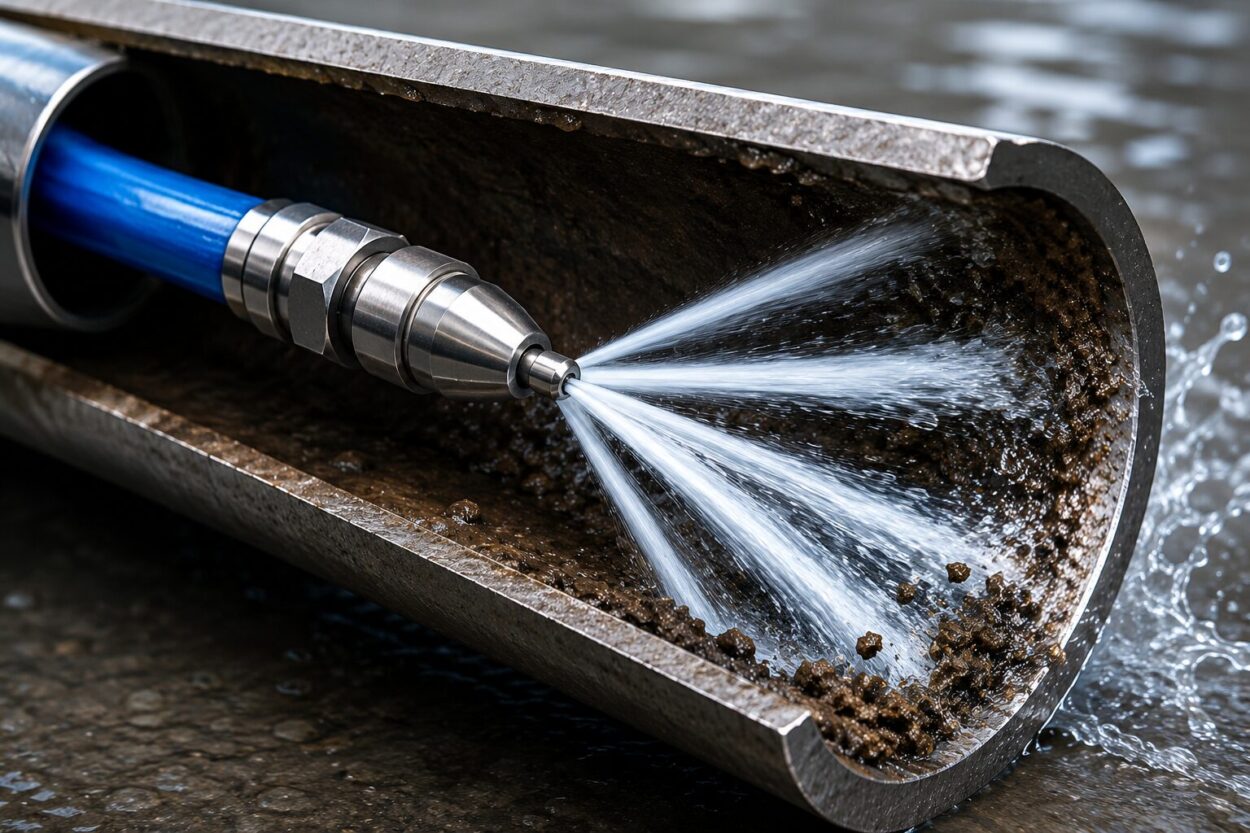
A specialized hose with a high-pressure nozzle is fed into your drain or sewer line. Water blasts out at 1,500 to 4,000 PSI — strong enough to cut through grease, mineral scale, and even small tree roots. The forward jet propels the hose through the line while the rear jets scour the pipe walls clean.
Unlike a snake that just creates a pass-through, hydro jetting cleans your pipes back to their original interior diameter. Years of buildup wash out the cleanout, leaving smooth pipe walls that won't catch new debris.
Mechanical Auger Cable
A flexible metal cable (also called an auger) is fed into your drain. The cable has a blade, corkscrew, or hook on the end that breaks up or pulls out the clog. The plumber rotates the cable to chew through the blockage or hook debris like hair clumps and tissue paper.
Snaking is fast and effective for blockages near the fixture — bathroom sinks, kitchen drains, toilets, single-line clogs. The trade-off: the snake punches through the clog, but it usually leaves residue coating the pipe walls, which is why snaked drains tend to re-clog within months.
Hydro Jetting vs. Snaking — Side-by-Side
The factors that matter most when you're deciding between the two.
| Hydro Jetting | Drain Snaking | |
|---|---|---|
| Cleaning Power | Cleans entire pipe wall | Punches hole through clog only |
| Best For | Grease, scale, tree roots, recurring clogs | Hair, soap, paper, simple single-line clogs |
| Long-Term Results | Months to years before re-clog | Weeks to months before re-clog |
| Time on Site | 1–2 hours typically | 30 minutes to 1 hour |
| Pipe Safety | Safe for modern PVC, ABS, sturdy pipes | Gentler — safer for old, fragile pipes |
| Camera Inspection Needed? | Yes — recommended before jetting | Usually no |
| Upfront Cost | Higher | Lower |
| Eco-Friendly | Water only, no chemicals | No chemicals, but less thorough |
| Effective on Tree Roots? | Yes | Limited — may push roots aside without removing |
When Hydro Jetting Is the Right Call
Hydro jetting is the heavy artillery of drain cleaning. We pull it out when the job needs more than a quick clog-punch. Common situations where jetting is the right answer:
- Recurring clogs — if you've called a plumber to snake the same line twice or more, jetting is what actually solves it
- Grease-heavy kitchen lines — snakes punch through grease but leave it coating the pipe; jetting flushes it out
- Tree root intrusion — high-pressure water cuts and flushes root masses from main sewer lines
- Mineral scale buildup — common in older Massachusetts homes with cast iron pipes and hard water
- Multiple slow drains — when toilets, tubs, AND sinks are all sluggish, the main line is partially blocked
- Preventative maintenance — for restaurants, older homes, or properties with chronic plumbing issues
We always run a video pipe inspection first to confirm the pipe is sound enough to handle the pressure. Want to learn more? See our hydro jetting service page.
When Drain Snaking Is the Smarter Choice
Snaking still earns its place. It's faster, gentler on pipes, and significantly less expensive — perfect when the clog is simple and local. We reach for the snake when:
- Single-fixture clogs — one bathroom sink, one tub, one toilet — that's a snake job
- Hair, soap, or paper blockages — snakes hook and pull these out cleanly
- Old or fragile pipes — cast iron from the 1950s, clay sewer lines, or pipes already showing weakness can't safely handle 4,000 PSI
- You need a fast, low-cost fix — snaking is the budget-friendly first move when the clog is straightforward
- Diagnostic snaking — sometimes we snake first just to see what comes out, which tells us if jetting will be needed next
If snaking solves the problem and the clog doesn't return, you didn't need jetting. We never upsell. See our full drain cleaning services.
The Honest Pros & Cons of Each
No method is perfect. Here's the straight talk on both — including the trade-offs most plumbers won't mention.
- Cleans the entire pipe wall, not just the clog
- Long-lasting results — buildup is gone, not pushed aside
- Removes grease, scale, and tree roots
- Eco-friendly — uses only water, no chemicals
- Great for preventative maintenance on older homes
- Higher upfront cost than snaking
- Not safe for old, fragile, or cracked pipes
- Requires a camera inspection first
- Takes longer per service call
- Fast — most clogs cleared in under an hour
- Affordable — the budget-friendly option
- Safer for older or weaker pipes
- Effective for simple, localized clogs
- No chemicals required
- Only addresses the blockage, not the pipe walls
- Residue left behind catches new debris quickly
- Re-clogs are common within months
- Limited effectiveness on tree roots or grease
Not Sure Which One Your Drain Needs?
That's what we're here for. Our licensed Massachusetts plumbers inspect first, diagnose accurately, and recommend the method that actually solves your problem — not the one that pads the bill.
What's Going On With Your Drain? (Quick Diagnosis)
Match your situation to the most common scenarios we see across Eastern Massachusetts homes.
Slow Drain in Just One Sink or Tub
→ Snake ItSingle-fixture clog. Usually hair, soap, or biofilm. Quick snake job — under an hour.
Kitchen Sink Backs Up Every Few Months
→ Hydro JetGrease buildup coating the pipe walls. Snaking won't remove it. Jetting flushes it clean.
Sewer Line Keeps Backing Up
→ Hydro Jet (After Camera)Tree roots or scale in the main line. Camera first to check pipe condition, then jet to clear.
Toilet Won't Flush — One Toilet Only
→ Snake ItLocalized toilet clog. Auger snake (closet auger) handles it fast.
Multiple Drains Are All Slow
→ Hydro JetMain line partially blocked. Snaking only buys you a few weeks. Jetting solves it.
You Have Old Cast Iron or Clay Pipes
→ Snake First, Camera AlwaysOlder pipes may not handle high-pressure jetting. Camera inspection determines if jetting is safe.
Foul Smell From Drains
→ Hydro JetOrganic buildup in the pipes. Jetting cleans the surfaces causing the smell, not just the clog.
Gurgling Toilets or Slow Drains After Storm
→ Hydro JetStorm water debris in the sewer line. Jetting flushes it out completely.
What Affects the Cost of Drain Cleaning?
We won't quote a number you can't trust — every job is different. Here's what actually moves the price on either service.
Pipe Length & Diameter
Longer runs and larger main lines take more time and equipment than a short bathroom drain.
Access Point
An existing cleanout is fast. Pulling a toilet or opening up a wall to reach the line costs more.
Severity of Blockage
A simple soap clog is quick. Heavy scale, embedded roots, or fully blocked sewer lines take longer.
Camera Inspection
Most hydro jetting calls include a camera inspection to confirm pipe condition first.
Emergency or After-Hours
Same-day or after-hours service costs more than a scheduled appointment, but stops the damage.
Pipe Age & Material
Older or fragile pipes may need extra care, additional repairs, or alternative methods to clear safely.
Drain Backing Up Right Now?
Don't wait — a slow drain becomes a sewage backup faster than most homeowners expect. A1 Discount Plumber offers same-day emergency drain service across Eastern Massachusetts.
Hydro Jetting vs. Snaking — Common Questions
The questions Massachusetts homeowners ask us most.
Hydro jetting is better for recurring clogs, grease, scale, tree roots, and full-pipe cleaning. Snaking is better for fast, affordable fixes on simple single-line clogs like hair or paper, and for old fragile pipes that can't handle high-pressure water. "Better" depends entirely on the clog and the condition of your pipes — which is why a camera inspection before jetting is standard practice.
The "1/3/5 rule" — sometimes referenced as the 135 rule — is an industry guideline about drain slope. Drainage pipes need a minimum slope of 1/4 inch per foot for proper flow on smaller lines, and different fall ratios apply to larger main lines depending on diameter. It's why poorly-sloped drains are a chronic source of recurring clogs no matter how often you snake or jet them — the water can't carry waste through the line. If your drains clog repeatedly despite cleaning, slope or venting issues may be the root cause.
Most plumbers — A1 included — recommend avoiding chemical drain cleaners like Drano. The active ingredients (sodium hydroxide or sulfuric acid) generate heat that can soften PVC pipes, corrode older metal pipes, eat through gaskets and seals, and damage rubber components in toilets. Worse, if it doesn't fully clear the clog, that chemical is now sitting in your line — and we have to work around it when we arrive. Mechanical solutions (snake or jet) are safer and more effective in nearly every case.
Hydro jetting cost varies based on pipe length, accessibility, severity of the blockage, whether a camera inspection is included, and whether it's emergency service. We provide flat-rate written quotes after a quick assessment — no hourly surprises. For most Massachusetts homes, jetting a main sewer line costs more than snaking a single drain, but the difference is usually justified by how long the fix lasts. Call us for a free estimate on your specific situation.
Yes — three main ones. First, it's not safe for old, brittle, or cracked pipes. The same pressure that cleans modern pipes can damage fragile ones. Second, it costs more upfront than snaking. Third, it requires more time on site and typically a camera inspection beforehand. These are why a good plumber inspects before jetting — to make sure your pipes can handle it and the method is actually the right call.
For a clogged toilet, plumbers first reach for a flange plunger (the bell-shaped kind, not the flat one). If that doesn't work, a closet auger (a specialized toilet snake) is the next step — it's designed to navigate the toilet's curved trap without scratching the porcelain. Chemical drain cleaners are not recommended for toilets. If the clog returns frequently or affects multiple toilets, the main line may need professional drain cleaning or a camera inspection.
WD-40 is sometimes used to clean hard water stains and mineral deposits from toilet bowls — it can help dissolve and lift stubborn rings. It does NOT unclog toilets. Spraying WD-40 into a clogged toilet won't help and can leave an oily residue. For actual clogs, use a flange plunger or call a plumber. For cleaning, white vinegar and a pumice stone work just as well as WD-40 without the residue.
Some minor toilet clogs — especially from organic waste or toilet paper — can break down on their own within a few hours to overnight. But this only works if the clog is soft and partial. Hard objects, wipes (even "flushable" ones), feminine products, or heavy paper accumulation won't resolve themselves. If the toilet hasn't drained within a few hours, don't keep flushing — you'll just push water onto the floor. Plunge it or call a plumber.
No. Rid-X is a maintenance product designed for septic systems — it adds beneficial bacteria and enzymes to help break down waste in the septic tank over time. It's not a drain cleaner and won't dissolve a current clog. For an active toilet clog, use a plunger or a closet auger, or call a plumber. Rid-X has a purpose, but unclogging is not it.
Hydro jetting is safe for modern PVC, ABS, and most properly-installed metal pipes when performed by a licensed professional. It can damage old cast iron, clay, or already-cracked pipes — which is why we always run a video pipe inspection before jetting. The camera shows us pipe condition, joint integrity, and any existing weaknesses. If the pipes can't handle jetting, we recommend snaking or a pipe repair instead. We never jet blind.
Yes. A1 Discount Plumber provides hydro jetting, drain snaking, camera inspections, and emergency drain cleaning across Eastern Massachusetts — including Acton, Acushnet, Ashland, Bellingham, Berkley, Berlin, Bolton, Boxborough, Dartmouth, Fall River, Foxborough, Grafton, and New Bedford. Call +1 (508) 556-2269 for same-day service.
Clear It Right the First Time.
Free inspection. Honest method recommendation. Same-day service across Eastern Massachusetts.