Sewer Line Repair & Trenchless Sewer Replacement in Eastern Massachusetts
Collapsed sewer line, tree root invasion, or a main line that backs up every few months? A1 Discount Plumber diagnoses with video camera first, then fixes it — with trenchless technology that saves your yard, driveway, and thousands in restoration costs.
Get a Free Sewer Line QuoteSewer Line Repair — What You Need to Know
Sewer line repair addresses cracked, collapsed, or root-invaded pipes connecting your home to the municipal sewer. Modern trenchless methods — Cured-In-Place Pipe (CIPP) lining and pipe bursting — fix the problem from inside the pipe or replace it underground without tearing up your lawn, driveway, or landscaping. The process starts with a video camera inspection to map exactly where the damage is, followed by clearing, then repair or full replacement. Trenchless repairs typically take one day and the new pipe can last 50+ years.
Your Main Sewer Line Is the Most Important Pipe You Never See
Every drain in your home — every toilet, sink, shower, and washer — feeds into one main sewer line running underground from your foundation to the municipal connection at the street. When that line fails, nothing drains. Wastewater backs up into your lowest fixtures. And every hour of delay makes the damage worse.
The problem is that most homeowners don't realize they have a sewer line issue until it becomes an emergency. Slow drains across the house, gurgling toilets, foul odors in the yard — these are all early warnings. A1 Discount Plumber has repaired and replaced sewer lines across Eastern Massachusetts for over two decades. We use video pipe inspection to find the exact problem, then apply the repair method that actually fits — whether that's trenchless lining, pipe bursting, or traditional excavation when the situation demands it.
How Trenchless Sewer Replacement Works
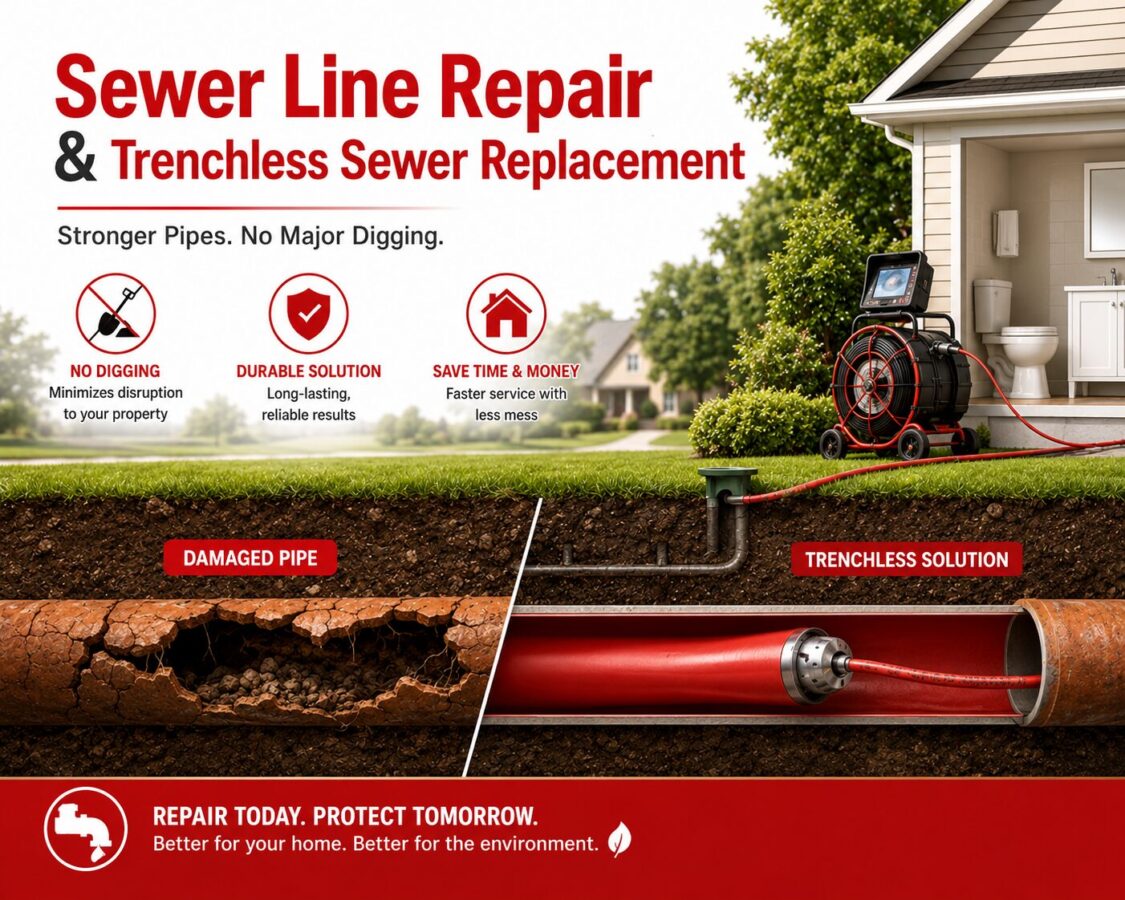
The side-by-side breakdown — a damaged pipe versus the trenchless solution. No major digging. Stronger pipes. Faster completion.
Signs Your Sewer Line Needs Repair
Sewer line damage rarely announces itself with a single dramatic event. It's usually a pattern of symptoms that build over weeks or months. Here's what to watch for.
Multiple Drains Backing Up
When toilets, tubs, and sinks all slow down at the same time, the blockage isn't in a single fixture — it's in the main sewer line that connects them all.
Foul Sewer Odors Inside or Outside
The smell of rotten eggs (hydrogen sulfide) near drains or in your yard signals a cracked or separated sewer pipe leaking gas and wastewater into the surrounding soil.
Suspiciously Lush Patches of Grass
Sewage is a potent fertilizer. If one strip of your lawn is noticeably greener or growing faster than the rest, a leaking sewer line may be feeding it from below.
Recurring Clogs After Cleaning
If drain cleaning fixes the problem for a few weeks but it keeps coming back, the real issue is structural — roots, cracks, or a collapsed section deeper in the line.
Gurgling Sounds From Toilets or Drains
Gurgling happens when air gets trapped by a partial blockage in the main line. The air pushes back through the water in your fixture traps, creating that distinctive bubbling sound.
Foundation Cracks or Settling
A leaking sewer line erodes the soil supporting your foundation. Over time, the slab sinks unevenly, causing cracks in walls, ceilings, and the foundation itself.
Unexplained Spike in Water Bill
If your water bill jumps without a change in usage, a pressurized supply line under the slab or in the yard may be leaking — feeding water into the soil 24/7.
Pest Infestations Near Foundation
Cracked sewer pipes attract rodents, cockroaches, and sewer flies. If pests suddenly appear near your basement or foundation, a broken line may be the entry point.
Sewer Line Backing Up Right Now?
Don't wait — sewage backups cause health hazards and property damage that compounds by the hour. A1 Discount Plumber offers same-day emergency sewer service across Eastern Massachusetts.
Step One: We See the Problem Before We Dig
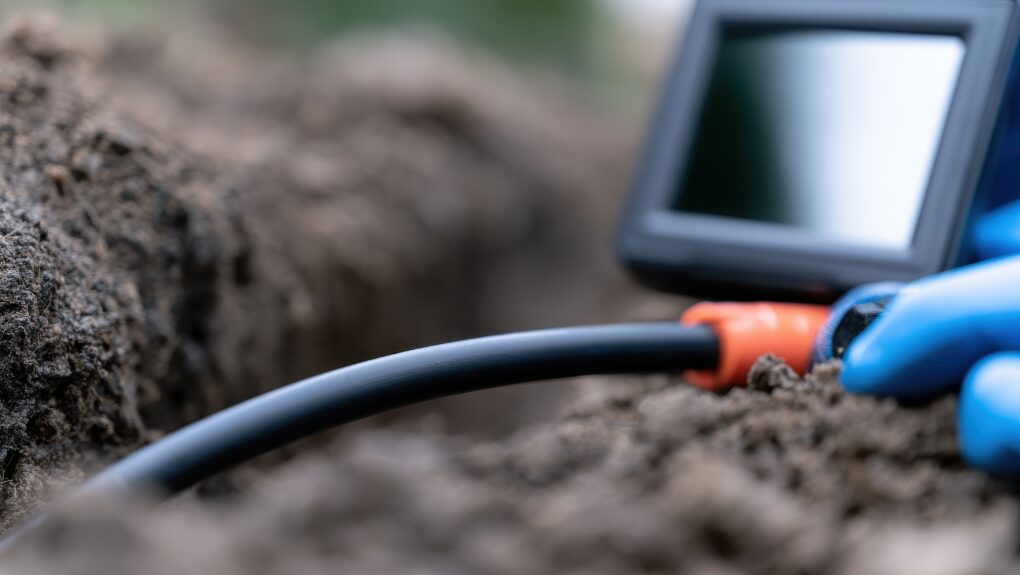
Every sewer line repair starts with a video camera inspection. We feed a high-resolution, waterproof camera through your sewer line to see exactly what's happening underground — without touching a shovel.
The camera maps the entire interior of the pipe, identifying:
- Tree root intrusions — roots enter through joints and cracks, growing until they block the line entirely
- Pipe cracks and fractures — caused by ground settling, heavy vehicle traffic above, or decades of wear
- Collapsed sections — where the pipe has physically broken apart and soil has filled the void
- Joint separations — where old clay or cast iron pipe sections have shifted apart
- Heavy scale and grease buildup — calcified deposits that narrow the pipe's effective diameter over years
This diagnostic step eliminates guesswork. We know the type of damage, the exact location, and the pipe material — so the repair recommendation is precise, not a guess. No camera, no quote.
Trenchless Repair vs. Traditional Excavation
Two ways to fix a broken sewer line. One tears up your property. The other doesn't. Here's the honest breakdown of both — because sometimes excavation is the right call.
Trenchless methods repair or replace the pipe from the inside — using existing access points like cleanouts. Your yard, driveway, and landscaping stay intact.
- No major digging — preserves landscaping, driveways, and hardscaping
- Typically completed in one day
- New liner or pipe lasts 50+ years
- Often cheaper total cost (no surface restoration bills)
- Jointless pipe — eliminates future root entry points
- Works on most pipe materials including cast iron and clay
- Not suitable for fully collapsed pipes with no path through
- Higher per-foot material cost than traditional pipe
- Requires an existing access point (cleanout or small entry pit)
A backhoe or excavator digs a trench along the pipe route. The old pipe is physically removed and a new pipe is laid in its place. Proven and reliable — but destructive.
- Works on completely collapsed lines where no path exists
- Lower per-foot pipe material cost
- Allows upsizing the pipe diameter during replacement
- Direct visual confirmation of the entire repair
- Destroys landscaping, driveways, walkways, and mature tree roots
- Surface restoration adds thousands to the final bill
- Multi-day project timeline
- Heavy equipment access required — not always possible in tight lots
- Massachusetts winter ground conditions make excavation slower and more expensive
Cured-In-Place Pipe (CIPP) Lining
CIPP lining is the most common trenchless repair method for residential sewer lines in Massachusetts. It creates a brand-new pipe inside your existing one — no digging required.
Here's how it works:
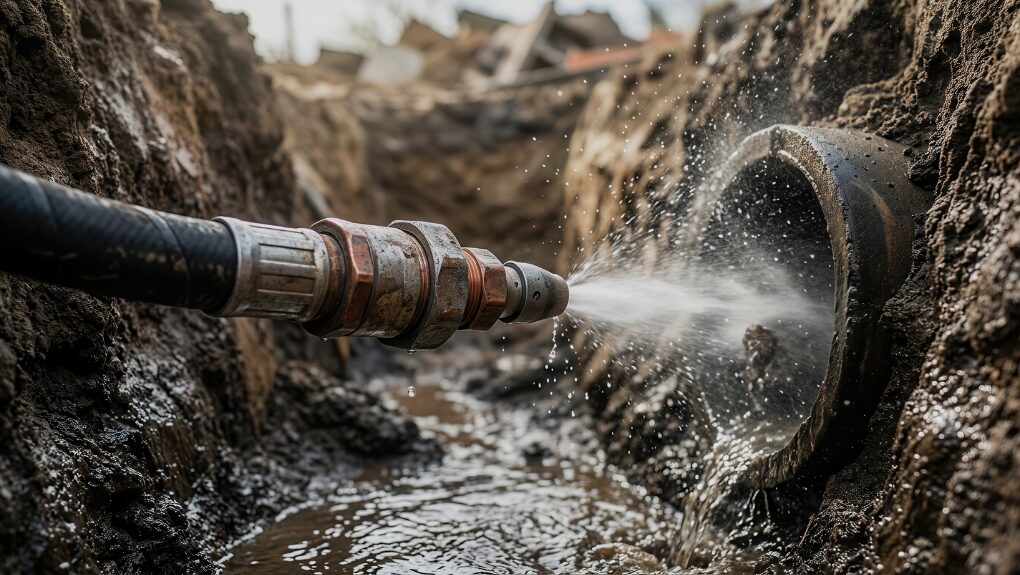
- Clear the line — roots, debris, and buildup are removed with hydro jetting to restore the full pipe interior
- Insert the liner — a flexible, resin-saturated felt tube is fed through the existing pipe via a cleanout or small access point
- Inflate and cure — the liner is expanded against the pipe walls and cured with heat or UV light, hardening into a seamless, jointless new pipe
- Final inspection — another camera pass confirms the liner is smooth, sealed, and structurally sound
The finished liner is corrosion-resistant, root-proof (no joints for roots to enter), and rated to last 40 to 50 years. It's especially effective for rehabilitating aging cast iron and clay pipes commonly found in older Massachusetts homes.
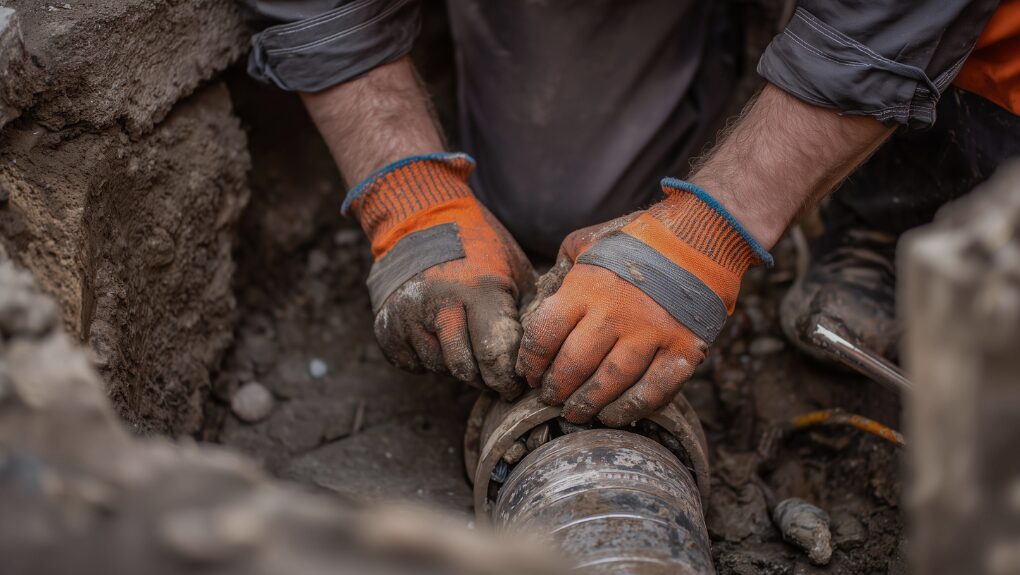
Pipe Bursting: Full Replacement Without Full Excavation
When the existing pipe is too far gone for lining — severely corroded, badly misaligned, or partially collapsed — pipe bursting replaces the entire line underground.
A hydraulic bursting head is pulled through the old pipe, shattering it outward into the surrounding soil while simultaneously dragging a new high-density polyethylene (HDPE) pipe into its place. One pass, one new pipe, minimal surface disruption.
- Full replacement — the old pipe is destroyed and replaced, not patched
- Allows upsizing — the new HDPE pipe can be larger diameter than the original
- HDPE is virtually indestructible — flexible, corrosion-proof, and root-resistant
- Minimal excavation — only small entry and exit pits are needed, not a full trench
- One-day completion — most residential pipe bursting jobs are done in a single visit
Pipe bursting is particularly effective in Massachusetts, where dense historical neighborhoods, mature trees, and winter ground conditions make full-trench excavation impractical and expensive.
How a Sewer Line Repair Works — Start to Finish
No surprises. No "we need to come back." Here's exactly what happens from the first call to the final camera verification.
Video Inspection
We run a high-resolution camera through your sewer line to map the damage — type, location, pipe material, and severity — before recommending anything.
Flat-Rate Quote
Written quote covering the repair method, materials, access requirements, and timeline. You know the total cost before we start.
Clear & Repair
We clear the line with hydro jetting, then execute the repair — CIPP lining, pipe bursting, or excavation — based on what the camera showed us.
Final Camera Pass
A post-repair camera inspection confirms the new pipe or liner is sealed, flowing, and structurally sound. You see the footage — proof the job is done right.
What Affects Sewer Line Repair Cost?
Every sewer line job is different. We won't quote a number you can't trust — here's what actually drives the price on your specific repair.
Length of the Run
A 20-foot section under the basement costs less than an 80-foot line running from the house to the street. Both trenchless and traditional methods are priced per linear foot.
Repair Method
CIPP lining and pipe bursting have higher material costs per foot but save thousands in surface restoration. Traditional excavation is cheaper per foot but adds driveway and landscaping bills.
Access & Depth
A cleanout at the foundation is fast access. A line buried 8 feet deep under a concrete driveway with no cleanout requires more setup — and more cost.
Soil & Obstacles
Massachusetts glacial soil often hides boulders that add removal costs during excavation. Trenchless methods bypass this problem entirely in most cases.
Diagnostics
Video camera inspection and any additional testing (hydrostatic pressure, smoke testing) are typically included or credited toward the repair quote.
Emergency vs. Scheduled
A planned sewer line repair costs less than an emergency dispatch at 2am on a Saturday. If your drains are slowing but still working, scheduling saves money.
Sewer Line Inspection — Know Before You Dig.
A 30-minute camera inspection tells you exactly what's happening underground. No guesswork, no unnecessary repairs. Schedule yours today — we serve all of Eastern Massachusetts.
Sewer Line Repair — Common Questions
The questions Massachusetts homeowners ask us most about sewer line problems and trenchless solutions.
Sewer line repair costs depend heavily on the method, length of the run, depth of the pipe, and site conditions. Trenchless CIPP lining typically runs $100 to $250+ per linear foot in materials, and pipe bursting falls in a similar range. Traditional excavation can be cheaper per foot for the pipe itself, but once you add surface restoration — driveways, landscaping, concrete — the total often exceeds trenchless. For a typical Massachusetts home needing 40 to 60 feet of sewer line work, total project costs commonly range from $6,000 to $15,000+. We provide flat-rate written quotes after the camera inspection so you know the exact cost before any work starts.
Usually, yes — when you compare total project cost. Trenchless materials cost more per foot than standard PVC or HDPE pipe, but you skip the massive restoration expenses that come with excavation. You don't pay to jackhammer and repour a driveway, replace landscaping, remove mature tree roots, or rent heavy excavation equipment. In Massachusetts, where glacial boulders, deep frost lines, and dense neighborhoods add excavation complexity, the total savings from trenchless methods are often significant.
Cured-In-Place Pipe (CIPP) lining creates a seamless, jointless pipe rated to last 40 to 50 years when installed by certified professionals. The epoxy resin is corrosion-resistant and root-proof — with no joints, there are no entry points for tree roots. HDPE pipe installed via pipe bursting is equally durable and has a similar multi-decade lifespan. Both methods outlast many traditional pipe materials, especially the clay and cast iron pipes they're typically replacing in older Massachusetts homes.
Yes. Trenchless CIPP lining is one of the best strategies for rehabilitating aging cast iron sewer pipes. The resin liner bonds to the interior of the existing cast iron, sealing cracks, bridging joint separations, and creating a smooth new flow surface. This is especially relevant in Massachusetts, where many older homes still have original cast iron or clay sewer lines that are deteriorating but structurally intact enough to accept a liner. If the cast iron has fully collapsed, pipe bursting is the trenchless alternative — it destroys the old pipe and pulls new HDPE through in one pass.
We use multiple diagnostic methods depending on the situation. Video camera inspection (CCTV) is the primary tool — it travels through the pipe and visually confirms cracks, offsets, root intrusions, and joint separations. For leaks that cameras can't fully confirm, hydrostatic pressure testing isolates sections of pipe and measures pressure loss. Smoke testing forces non-toxic smoke into the line to reveal breaches where smoke escapes through the ground or through gaps. Acoustic detection amplifies the sound of pressurized water escaping a crack underground. We start with the camera and escalate diagnostics only if needed.
Standard homeowners insurance typically covers the water damage caused by a sewer backup inside your home — ruined drywall, warped floors, mold remediation. However, it usually does not cover the cost of repairing the actual broken sewer pipe itself. Some policies offer a specific "service line endorsement" or "sewer backup rider" that extends coverage to the pipe repair. If the insurer determines the damage resulted from long-term neglect rather than a sudden event, they may deny the claim entirely. Check your policy or call your agent to confirm your specific coverage before a problem occurs.
A professional sewer camera inspection typically costs between $150 and $350, depending on the length of the line and your region. Many plumbing companies — A1 included — credit the camera inspection fee toward the cost of the repair if you hire them to complete the work. The inspection is the single most valuable diagnostic step: it shows you exactly what's wrong, where it is, and what it will take to fix — before any money is spent on the actual repair.
In Massachusetts, the homeowner is responsible for the lateral sewer line running from the house to the connection point at the municipal main — which is typically located at the property line or in the street. The municipality maintains the main sewer line itself. This means if your lateral line is cracked, root-invaded, or collapsed, the repair cost is yours. Some municipalities and utility companies offer service line warranty programs that cover lateral repairs for a monthly fee — worth investigating before you have a problem.
Most residential trenchless sewer repairs — both CIPP lining and pipe bursting — are completed in a single day. The process includes camera inspection, line clearing, the actual lining or bursting work, curing time (for CIPP), and a final verification camera pass. Traditional excavation typically takes two to five days depending on the length of the run, depth, and surface restoration required. In Massachusetts winter conditions, excavation timelines can extend further due to frozen ground and shorter daylight hours.
CIPP lining repairs the existing pipe by creating a new pipe inside it — a resin-coated liner is inserted, inflated against the pipe walls, and cured in place. The old pipe stays in the ground and acts as the outer shell. Pipe bursting destroys the old pipe entirely — a hydraulic head shatters it outward while pulling a brand-new HDPE pipe through the same path. CIPP is ideal when the existing pipe is cracked or root-invaded but still structurally intact. Pipe bursting is the right call when the pipe is too far gone for lining — severely corroded, misaligned, or partially collapsed.
Yes. A1 Discount Plumber provides sewer line repair, trenchless CIPP lining, pipe bursting, video camera inspections, and emergency sewer service across Eastern Massachusetts — including Acton, Acushnet, Ashland, Bellingham, Berkley, Berlin, Bolton, Boxborough, Dartmouth, Fall River, Foxborough, Grafton, New Bedford, and Taunton. Call (508) 556-2269 for same-day service or to schedule a camera inspection.
Sewer Line Repair & Trenchless Service Across Eastern MA
Acton • Acushnet • Ashland • Bellingham • Berkley • Berlin • Bolton • Boxborough • Dartmouth • Fall River • Foxborough • Grafton • Mansfield • New Bedford • Taunton • And surrounding Eastern Massachusetts communities.
Fix It Right. Fix It Once.
Video camera diagnosis. Honest repair recommendation. Same-day emergency service across Eastern Massachusetts.